← Players
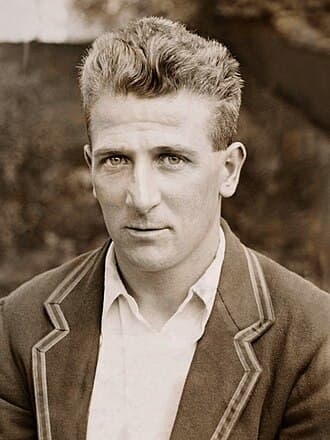
Harold Larwood

Harold Larwood

England·Bowler

The chief weapon of the Bodyline series whose pace caused injuries and outrage. He never played for England again after refusing to apologize.

24 incidents documented

Controversies & Incidents

Moderate

John Snow 7/40 — England Regain the Ashes, Sydney 1971

Australia vs England

12-17 February 1971

England regained the Ashes after twelve years on 17 February 1971 at Sydney, winning the seventh Test by 62 runs to take the series 2-0. John Snow's 7/40 in the second innings was the defining performance, but the Test was equally remembered for the bouncer that felled Terry Jenner, the bottle-throwing crowd disturbance, and Ray Illingworth leading his team off the field — and for the Test debut, in the previous Adelaide match, of a 21-year-old Dennis Lillee who took 5/84.

#1970-71 Ashes#John Snow#Ray Illingworth
Mild

John Snow — England's New Fast Bowling Threat Emerges, 1968

England vs Australia

1968-06-01

John Snow of Sussex emerged in the 1968 Ashes as England's most genuinely fast bowler since Trueman's peak — a right-arm quick with a classical side-on action, real hostility and the ability to move the ball off the seam. He took 17 wickets in the 1968 series and 31 wickets in the 1970-71 Ashes, England's most famous series win in Australia in a generation.

#john-snow#fast-bowling#england
Moderate

Fred Trueman 8 for 31 — India Routed at Old Trafford, 1952

England vs India

1952-07-19

On 17 July 1952 at Old Trafford, the 21-year-old Yorkshire fast bowler Fred Trueman tore through India's first innings to take 8 for 31 in 8.4 overs — at the time the best Test innings figures by an England fast bowler since Jim Laker's spin and the best by an out-and-out paceman in Test history. India were dismissed for 58 and 82 in a single day's play, beaten by an innings and 207 runs. Trueman's series haul of 29 wickets at 13.31 announced the most charismatic English fast bowler of his generation.

#england#india#fred-trueman
🔥Serious

MCC Outlaws Bodyline — The 'Direct Attack' Law of 1935

MCC / global

1935-04-01

Two and a half years after Adelaide, the MCC formally amended the Laws of Cricket to give umpires the power to stop bowling that constituted a 'direct attack' on the batsman. The 1935 amendment was the legal full stop on Bodyline. Fast leg theory, until then merely 'against the spirit of the game,' became something an umpire could call dead and intervene against. Bouncers became a rationed weapon for the next two generations.

#bodyline#laws-of-cricket#mcc
🔥Serious

Jardine Stands Down — March 1934

England

1934-03-21

On 21 March 1934 Douglas Jardine wrote to The Cricketer that he had 'neither the desire nor the intention' of playing in the upcoming home Ashes series. The announcement, taken as a quiet resignation, removed the architect of Bodyline from the field before Australia returned to England — a precondition Australia's Board had implicitly demanded.

#douglas-jardine#1934#resignation
Serious

Eddie Paynter Leaves Hospital Bed to Score 83 — Brisbane, 1933

Australia v England

1933-02-14

With the fate of the Bodyline series in the balance and England 216 for 6 chasing 340, Eddie Paynter checked himself out of a Brisbane hospital where he was being treated for acute tonsillitis, taxied to the Gabba in pyjamas and a dressing gown, and batted for nearly four hours to score 83. England drew level on first innings, won the Test by six wickets and the series 4-1.

#bodyline#ashes#1933
🔥Explosive

Adelaide Test 1933 — Woodfull, Warner and the 'Two Teams' Line

Australia v England

1933-01-14

On 14 January 1933 a Larwood bouncer felled Australian captain Bill Woodfull over the heart, the crowd nearly came over the fence, and that evening MCC manager Pelham Warner walked into the home dressing room to be told, 'There are two teams out there. One is trying to play cricket, the other is not.' The exchange leaked, the Adelaide Test became the diplomatic flashpoint of Bodyline, and the most famous sentence in Anglo-Australian cricket entered the language.

#bodyline#adelaide#1933
🔥Explosive

Bert Oldfield's Skull Fractured by Larwood — Adelaide, 1933

Australia v England

1933-01-16

Two days after Woodfull was struck over the heart, Australian wicketkeeper-batsman Bert Oldfield top-edged a Harold Larwood lifter into his own temple at Adelaide. The blow fractured his skull. Crucially, the field was conventional — not the leg-theory cordon — but the crowd did not know that. Mounted police lined the boundary as Oldfield was carried off; the Adelaide Test came within a single Australian Board decision of being abandoned.

#bodyline#oldfield#larwood
🔥Serious

Harold Larwood's Last Test — A 98 With a Broken Foot, 1933

Australia v England

1933-02-23

In the fifth Test at Sydney in February 1933, Harold Larwood broke two bones in his left foot bowling Bodyline at top pace — and Douglas Jardine kept him on the field, refusing to let him leave until Don Bradman was dismissed. Hobbling, Larwood went out to bat at No. 4 and made 98. He never played another Test. The Bodyline tour's spearhead was effectively retired by the captain who had unleashed him.

#larwood#bodyline#1933
Serious

Larwood's 33 Wickets — The Bodyline Series Tally, 1932-33

Australia v England

1933-02-28

Across the five Tests of the Bodyline series in 1932-33, Harold Larwood took 33 wickets at 19.51 — still the highest haul by an English fast bowler in an Ashes series in Australia. Including his unlikely 98 with the bat in his last Test, Larwood's tour was statistically the most dominant by a touring fast bowler since SF Barnes a quarter-century earlier.

#larwood#bodyline#1932-33
🔥Explosive

The Bodyline Series

Australia vs England

2 December 1932

The 1932-33 Bodyline series: England captain Douglas Jardine directed Harold Larwood to bowl short-pitched leg-theory at batsmen's bodies to stop Don Bradman. Nearly caused a diplomatic rupture between England and Australia; England won 4-1.

#bodyline#bodyline series#bodyline cricket
🔥Serious

Douglas Jardine Appointed Ashes Captain, August 1932

England

1932-08-12

In August 1932 the MCC selectors confirmed Douglas Jardine as England's captain for the 1932-33 tour of Australia, a decision contested at the highest levels of English cricket and one that — combined with Plum Warner's appointment as tour manager — would set the conditions for the Bodyline series.

#douglas-jardine#1932#captaincy-appointment
Serious

Pataudi Sr's Hundred on Ashes Debut — Sydney, December 1932

Australia v England

1932-12-02

On 2 December 1932 the Nawab of Pataudi Sr scored 102 on his Ashes debut at Sydney, the first Indian-born cricketer to make a hundred on Ashes debut. He played one more Test of the series and never another for England, his innings now a footnote inside the larger story of Bodyline.

#iftikhar-ali-khan-pataudi#ashes#1932
Serious

Hedley Verity's 10 for 10 — The Best Figures in First-Class History, 1932

Yorkshire v Nottinghamshire

1932-07-12

On 12 July 1932, slow left-armer Hedley Verity took 10 wickets for 10 runs at Headingley, dismissing a strong Nottinghamshire side for 67 in their second innings. The figures — 19.4 overs, 16 maidens, 10 for 10 — remain the best bowling analysis in the history of first-class cricket. Inside the spell were seven wickets in 15 deliveries, and a hat-trick. Yorkshire won by 10 wickets.

#hedley-verity#yorkshire#nottinghamshire
Serious

Stan McCabe's 187* — The Innings That Defied Bodyline, Sydney 1932

Australia v England

1932-12-03

In the first Test of the Bodyline series, with Bradman absent through illness and Australia 3 for 82, the 22-year-old Stan McCabe took on Larwood and Voce's leg-theory and counter-attacked his way to 187 not out off 233 balls. The innings included 25 fours and a string of hooks against the line of fire that briefly forced Jardine to drop the Bodyline field. Australia still lost the Test by ten wickets, but McCabe's century stands as one of the great acts of physical and moral courage in Test cricket.

#stan-mccabe#bodyline#ashes
Serious

Eddie Gilbert Knocks the Bat from Bradman's Hand at the Gabba, 1931

Queensland v New South Wales

1931-11-06

On 6 November 1931 at the newly opened Gabba, the Indigenous Queensland fast bowler Eddie Gilbert produced a six-ball over to Don Bradman that the world's best batsman would later call the fastest he had ever faced. Gilbert clipped Bradman's cap, sent a ball over his head, knocked the bat clean out of his hands, then had him caught behind for a duck. It is one of the most discussed overs in Australian cricket and the central episode in the tragic, unfinished story of an Aboriginal bowler whose action was ruled illegal but whose pace nobody disputed.

#eddie-gilbert#don-bradman#queensland
Serious

Bradman's 334 at Headingley — 309 in a Day, 1930

England v Australia

1930-07-11

On 11 July 1930 a 21-year-old Don Bradman walked in at 1 for 1 and by stumps had scored an unbeaten 309 — still the only triple-century in a single day's Test play. He went on to 334 the next morning, then the highest individual score in Test cricket, surpassing Andy Sandham's 325. The match drew, but the innings catapulted Bradman from prodigy to phenomenon and underwrote his world-record series tally of 974 runs.

#don-bradman#ashes#1930
Serious

Bradman's 232 at The Oval — Ashes Reclaimed, 1930

England v Australia

1930-08-16

With the series locked at 1-1 and the Ashes on the line, Bradman walked out at The Oval and made 232 across two days. Australia won by an innings and 39 runs, regained the urn, and finished a series in which Bradman had averaged 139.14. It was the innings during which Douglas Jardine, watching from the pavilion, began thinking seriously about leg theory.

#don-bradman#ashes#1930
Mild

Chapman's Ashes — England Win 4-1 in Australia, 1928-29

Australia v England

1929-03-08

Percy Chapman's England side, led by Hammond's record 905 runs and supported by the new-ball pair of Larwood and George Geary, won the 1928-29 Ashes 4-1 — the first English Ashes win in Australia for 17 years and the series in which a 20-year-old Don Bradman made his Test debut.

#percy-chapman#ashes#1928-29
Mild

Don Bradman's Test Debut — Brisbane, November 1928

Australia v England

1928-11-30

On 30 November 1928 the 20-year-old Don Bradman made his Test debut against England at the Exhibition Ground in Brisbane. He scored 18 and 1 as Australia were beaten by 675 runs — the largest defeat in Test history at the time — and was dropped for the next Test before returning to begin a career that would average 99.94.

#don-bradman#test-debut#australia
Mild

Harold Larwood Emerges — Nottinghamshire's Pace Spearhead, 1927-28

Nottinghamshire and English county cricket

1928-09-30

Across the 1927 and 1928 county seasons the 23-year-old Notts miner Harold Larwood took 100, 138 and then 138 wickets — establishing himself as the fastest bowler in England and securing his place in the 1928-29 Ashes side that would, four years later, take its leg-theory plans to Australia.

#harold-larwood#nottinghamshire#england
Mild

Wilfred Rhodes Recalled at 48 — England Regain the Ashes, Oval 1926

England v Australia

1926-08-18

Recalled to the England side aged 48 years and 165 days, Wilfred Rhodes took 4 for 44 in Australia's second innings at the Oval in August 1926, helping to win England's first Ashes series since 1912. He remains the oldest man ever to play Test cricket.

#wilfred-rhodes#ashes#1926
Mild

Hobbs and Sutcliffe Bat the Sticky — Oval, August 1926

England v Australia

1926-08-16

On the third morning of the fifth Test of 1926, after overnight thunderstorms had turned the Oval pitch into one of the most treacherous in Test history, Jack Hobbs and Herbert Sutcliffe added 172 for the first wicket — Hobbs 100, Sutcliffe 161 — in an innings widely regarded as the finest piece of opening batting in cricket.

#jack-hobbs#herbert-sutcliffe#ashes
Mild

Gregory and McDonald — The Pace Pair Who Broke England, 1921

Australia v England

1921-08-15

Through the summer of 1921 Jack Gregory and Ted McDonald operated as the most feared new-ball pair the world had yet seen. Together they took 46 wickets in the five Tests as Warwick Armstrong's Australians won the series 3-0, and inspired a decade of English broadcasting and journalism that would obsess about pace until Larwood's Bodyline answer arrived ten years later.

#jack-gregory#ted-mcdonald#pace-bowling