🥊Mild
Stuart Broad Counts Down Steve Smith's Farewell at The Oval
England vs Australia
31 July 2023
Stuart Broad, in his final Test, cheekily counted down to Steve Smith's supposedly final Test innings, winding up the Australian.
#broad#smith#ashes
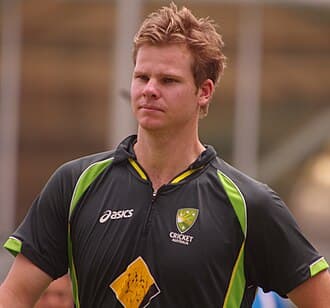
A batting genius whose career was rocked by the Sandpapergate scandal in 2018. His tearful press conference became one of cricket's most emotional moments.
30 incidents documented
England vs Australia
31 July 2023
Stuart Broad, in his final Test, cheekily counted down to Steve Smith's supposedly final Test innings, winding up the Australian.
ICC / Various Nations
1 January 2020
The ICC's proposal to reduce Test matches from five days to four sparked fierce opposition from players and purists who argued it would fundamentally alter cricket's oldest format.
England vs Australia
14-18 August 2019
Marnus Labuschagne replaced Steve Smith as cricket's first concussion substitute after Smith was hit by a Jofra Archer bouncer. England questioned whether it was a like-for-like replacement.
England vs Australia
17 August 2019
Jofra Archer's fierce bouncer struck Steve Smith on the neck, felling him and forcing him out of the next Test with delayed concussion symptoms.
Australia vs South Africa
24 March 2018
Cameron Bancroft was caught on camera using sandpaper to tamper with the ball during the Cape Town Test, leading to bans for Bancroft, captain Steve Smith, and vice-captain David Warner in the most damaging scandal in Australian cricket history.
South Africa vs Various
24 March 2018
Kagiso Rabada accumulated demerit points for aggressive celebrations and physical contact with batsmen after dismissals, nearly missing key matches.
Australia vs South Africa
3 March 2018
The Warner-de Kock feud set the toxic tone for the entire 2018 Australia-South Africa series that culminated in the Sandpapergate scandal.
Australia vs South Africa
24 March 2018
Cameron Bancroft was caught on camera using sandpaper to tamper with the ball during the third Test at Cape Town, in a plan hatched by David Warner and known to captain Steve Smith, leading to unprecedented bans.
Pakistan vs Australia
20 March 2015
Wahab Riaz bowled a fearsome spell of fast bowling to Shane Watson in the World Cup quarter-final, hitting him multiple times and sledging aggressively.
South Africa vs Australia
2006-03-12
South Africa chased 434 off 50 overs to beat Australia 438-9 vs 434-4 at Johannesburg on 12 March 2006 — the highest successful ODI run chase ever. Australia thought a 434 total was unassailable; South Africa proved otherwise with 4 balls to spare.
England vs South Africa
26 July 2004
South Africa were accused of ball tampering during the third Test against England at The Oval in 2004, with the ball being replaced by umpires.
Australia vs Various
1993-01-01
Merv Hughes, the moustachioed Australian fast bowler, was famous for his creative and hilarious sledging that often left batsmen and teammates in stitches.
Australia vs Various
28 December 1991
Merv Hughes was legendary for his creative and often hilarious sledging, engaging in memorable verbal battles with Javed Miandad, Viv Richards, and many others.
Australia vs England
1966-02-11
On 11-12 February 1966 Victoria's Bob Cowper batted for twelve hours and seven minutes to score 307 against England at the MCG — then the highest score ever made by an Australian at home, and still the longest innings in Australian Test history. England's attack, containing Snow, Brown and Allen, bowled 138 overs at Cowper before he was finally out. Australia declared at 543 for 8 and the match was drawn.
England vs New Zealand
1965-05-27
At Edgbaston in May 1965, England's most prolific batsman of the era spent 437 minutes making 137 against a weak New Zealand attack. Ken Barrington was dropped for the next Test as a public warning about scoring rates — a punishment unprecedented for a Test centurion. He returned a fortnight later, made 163 against the same opposition, and was never disciplined that way again.
England vs New Zealand
1965-07-09
On 9 July 1965 at Headingley, Surrey opener John Edrich became the first Englishman since Len Hutton to pass 300 in a Test innings, finishing 310 not out against New Zealand. He hit 52 fours and five sixes — 238 runs in boundaries, a Test record that has stood for more than sixty years. England declared at 546 for 4 and won by an innings.
India vs England
1964-02-08
On 8 February 1964 at Delhi's Feroz Shah Kotla, India captain Mansur Ali Khan Pataudi made an unbeaten 203 against England in the fourth Test — the first double century by an Indian batsman in India and the highest individual score by an Indian Test captain at the time. Pataudi was 23 and had been playing with one effective eye for two and a half years.
England vs South Africa
1960-06-25
On 25 June 1960, the 21-year-old South African Geoff Griffin took the first Test hat-trick ever recorded at Lord's — and was no-balled eleven times for throwing in the same match. After the Test ended early on the fourth day, the umpires no-balled him repeatedly in the exhibition match staged to fill the unused time, forcing him to complete the over underarm. He never played another Test.
England v South Africa
1929-08-19
Nummy Deane's South Africans played five Tests in England in the long summer of 1929, losing the series 0-2 with three drawn but providing Hammond, Sutcliffe and Woolley with their first sustained run of home Test runs since 1926.
South Africa v England
1928-03-14
Ronnie Stanyforth's MCC tourists won the 1927-28 series in South Africa 2-1 with two drawn — the second consecutive English win in the country. Wally Hammond made his Test debut and a maiden Test hundred (51 in his first innings, then 90 and 66*) and the off-spin of George Geary took 19 wickets in five Tests at 20.
Warwickshire and England
1922-09-15
Ernest 'Tibby' or 'Tiger' Smith of Warwickshire kept wicket for England in 11 Tests between 1911 and 1914 and remained one of the most respected glove technicians in county cricket through the 1920s — keeping in 21 first-class seasons before becoming a coach to Don Bradman in his 1948 tour.
Nottinghamshire, England
1903-05-19
Arthur Shrewsbury, the Nottinghamshire opener whom W.G. Grace called the only contemporary he would 'rather have in my side', shot himself at his sister's home in Gedling on 19 May 1903 aged 47. Convinced he was incurably ill — though doctors had repeatedly told him otherwise — he had bought a revolver in mid-April and shot himself first in the chest, then in the head when the first wound proved non-fatal. The Notts side at Hove abandoned their match the next morning.
England v Australia
1891-12-15
When the Earl of Sheffield financed an English tour of Australia in 1891-92 with WG Grace as captain, he ended the trip by donating £150 to the New South Wales Cricket Association to fund a perpetual trophy for inter-colonial cricket. The result: the Sheffield Shield, contested between NSW, Victoria and South Australia from 1892-93 onwards, and the foundational competition of Australian first-class cricket.
South Africa v England
1889-03-12
On 12-13 March 1889, at St George's Park, Port Elizabeth, South Africa became the third Test-playing nation. England, captained by C Aubrey Smith — later a Hollywood actor — won by 8 wickets inside two days. Smith took 5 for 19 in the first innings, his only Test wickets; Owen Dunell, the South African captain, became the first man to lose a Test toss for South Africa.
South Africa v England
1889-03-25
On 25-26 March 1889 at Newlands, Lancashire's Johnny Briggs took 7 for 17 and 8 for 11 against South Africa — match figures of 15 for 28, of which 14 were bowled and one lbw. It set a new Test record for match wickets that lasted until SF Barnes in 1913, and remains one of the most economical 15-wicket hauls in any form of cricket.
England (cricket) / Hollywood (film)
1889-03-12
C Aubrey Smith captained England in his only Test in 1889, took 5 for 19, and never played another international. Forty-three years later, the same man — now a Hollywood character actor in his seventies — founded the Hollywood Cricket Club, persuaded Boris Karloff and David Niven to play, and lived in Beverly Hills until his death in 1948. The arc from St George's Park to Beverly Hills is one of cricket's strangest biographies.
England v South Africa
1889-03-12
Charles Aubrey Smith was a tall fast-medium Sussex amateur with one of the strangest run-ups in cricket history — a sweeping curve that started from deep mid-off or even from behind the umpire and brought him in at the crease from an unexpected angle. WG Grace remarked it was 'rather startling when he suddenly appears at the bowling crease'. In March 1889, Smith captained the first English side to play a Test in South Africa, took 5/19 in the first innings of that Test, and remains the only player ever to captain England in his one and only Test appearance.
R.G. Warton's XI (England) v South African sides
1888-12-01
The first English cricket tour of South Africa was organised not by MCC or any official body but by a retired British army officer, Major Robert Gardner Warton, working with two Cape Town agents (Billy Simkins and William Milton) and underwritten by the shipping magnate Sir Donald Currie. Warton went to England in 1888 to recruit professionals; the resulting team — captained by the amateur C. Aubrey Smith — sailed in November and played the matches that were later, in 1903, given retrospective Test status as South Africa's first Tests.
n/a
1835-07-10
The earliest documented cricket match at Charterhouse School — then on its London Smithfield site — was an inter-form fixture played in the summer of 1835. Charterhouse cricket had been informal through the late eighteenth century; the 1835 match is the earliest with surviving documentation in the school's records. Charterhouse would, by the late nineteenth century, become a notable cricketing school.
Hampshire vs England
1802-07-08
Robert Robinson of Farnham, who had lost the use of his right hand in a childhood accident and gripped the bat with a leather-and-iron sheath, appeared for Hampshire against England at Lord's in July 1802. He scored a fluent 30 in the first innings — the first half-century-class score by a one-handed batter in major cricket — and helped Hampshire to a draw against the strongest side of the day.