🏏Serious
Stuart Broad Refuses to Walk — Ashes 2013
England vs Australia
10-14 July 2013
Stuart Broad edged a ball clearly to slip but was given not out. He refused to walk, and Australia had no DRS reviews left.
#broad#ashes#not walking
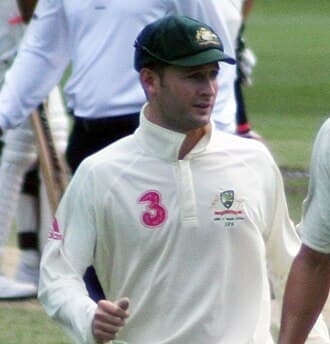
Australia's captain who was involved in several on-field controversies, including the 'get ready for a broken arm' sledge to Jimmy Anderson.
62 incidents documented
England vs Australia
10-14 July 2013
Stuart Broad edged a ball clearly to slip but was given not out. He refused to walk, and Australia had no DRS reviews left.
South Africa vs Various
3 January 2013
Dale Steyn was known for his aggressive celebrations and confrontational send-offs, frequently getting in batsmen's faces after dismissing them.
England vs Australia
2013-07-10
Stuart Broad edged massively to slip but stood his ground and was given not out by the umpire, brazenly refusing to walk in one of the Ashes' most shameless moments.
Australia (internal incident)
7 January 2009
Simon Katich grabbed Michael Clarke by the throat in the Australian dressing room after Clarke wanted to leave before the team victory song.
Australia vs India
2-6 January 2008
One of the most controversial Tests ever — terrible umpiring decisions, racial abuse allegations, and India threatening to abandon the tour.
Various
2003-02-01
New Zealand umpire Billy Bowden became famous for his flamboyant, theatrical umpiring style including his signature 'crooked finger of doom' dismissal.
West Indies, South Africa
1983-01-19
Captained by Jamaican batsman Lawrence Rowe, two unauthorised West Indies XI tours of apartheid South Africa in 1982-83 and 1983-84 led to lifetime bans by the WICB and the social ostracism of all 18 squad members across the Caribbean.
England, Australia
1903-12-11
Reginald Erskine 'Tip' Foster scored 287 on Test debut at Sydney in December 1903, then the highest individual score in Test cricket. It remained a world record until 1930 and is still the highest score by any Test debutant. Foster's epic dragged England, captained by Plum Warner, from 73 for 3 to a first innings of 577 and the platform for an Ashes-winning campaign.
England (Bligh's XI) v Australia
1884-02-09
When the Hon Ivo Bligh's England party arrived at Rupertswood near Sunbury for Christmas 1882, the captain was introduced to Florence Rose Morphy, music teacher and companion to Lady Janet Clarke, mistress of the house. The Ashes urn that emerged from the festivities was presented partly by Florence; within a year she and Bligh were engaged, and on 9 February 1884 they were married at Rupertswood. The Ashes therefore originate not just from a Sporting Times joke but from one of cricket's only real love stories.
England v Australia
1882-12-30
Six weeks after the Sporting Times mock obituary, the Hon Ivo Bligh sailed for Australia at the head of a private English team with the explicit, half-joking goal of bringing 'the Ashes' home. England lost the first Test at Melbourne, won the next two at Melbourne and Sydney to take the official series 2-1, and at the end of the tour Bligh was presented with a small terracotta urn that, decades later, became the most famous trophy in cricket.
England v Australia
1882-12-25
Sometime over Christmas and Easter 1882-83, at the Rupertswood estate of Sir William Clarke at Sunbury, near Melbourne, the Hon Ivo Bligh was presented with a small terracotta urn 10.5 cm high that was said to contain the ashes of a burnt bail. The presentation, initially a private joke during a country-house cricket match, eventually produced the most famous trophy in the sport.
England (Bligh's XI) v Australia
1882-12-25
What is actually inside the Ashes urn? For over a century the standard answer was 'a burnt cricket bail', but in 1998 the 8th Earl of Darnley's daughter-in-law claimed the contents were the burnt remains of a lady's veil, possibly belonging to Florence Morphy or Lady Janet Clarke. MCC, which has had the urn since 1927, has never officially confirmed either version. After a 2006-07 examination an MCC official said it was '95 per cent certain' the contents were a bail — leaving 5 per cent of cricket's most famous mystery still open.
All-England Eleven vs United All-England Eleven; vs touring sides
1870-09-01
George Parr — captain of Nottinghamshire from 1856 to 1870 and of the All-England Eleven over the same period — was the dominant figure in English professional cricket between William Clarke's death and W.G. Grace's emergence. Tour captain in North America in 1859 and Australasia in 1863-64, he scored 6,626 first-class runs at 20.20 in conditions that were brutal to batters, and ran the AEE through the great rivalry years against the United All-England Eleven from 1857 to 1866.
Nottinghamshire and All-England representative sides
1869-08-01
George Parr, the Lion of the North, played his final first-class season in 1869 and retired from the game he had dominated as England's premier batsman for fifteen years. His career spanned the transition from roundarm to overarm bowling, from county cricket without a championship to county cricket in its organised modern form, and from the All-England Eleven touring era to the beginnings of Test cricket. His farewell was the end of an epoch.
Nottinghamshire CCC and county cricket administration
1863-04-01
Trent Bridge underwent significant improvements through the 1860s as Nottinghamshire county cricket consolidated its position as one of England's strongest counties. The ground that William Clarke had developed from the 1830s was enlarged, a proper pavilion constructed, and the playing surface improved to a standard that attracted major representative fixtures. The Trent Bridge of the 1860s was the prototype of the modern county ground.
Sussex, Kent, Middlesex; All-England Eleven; United All-England Eleven
1863-09-01
Long before John Wisden's name appeared on the spine of an almanack, he was the most feared fast bowler of his generation. At five feet four he was the smallest fast bowler in first-class history; nicknamed the 'Little Wonder' by umpire Bob Thoms, he took more than 1,000 first-class wickets at 6.66 between 1846 and 1863. In 1850 at Lord's he took all ten North-South wickets in an innings — every one bowled, the only ten-bowled innings in first-class history.
Albert Cricket Club, Sydney; later New South Wales
1862-04-01
When the H.H. Stephenson tour of 1861-62 ended in March 1862, the Surrey-Middlesex left-armer Charles Lawrence stayed behind in Sydney rather than sail home. Engaged by the Albert Cricket Club at Redfern at £300 a year, he became the first paid professional cricket coach in Australian history, captained New South Wales, opened a sports goods shop in George Street, and laid the structural foundations on which the colonial game grew toward Test status.
Nottinghamshire Cricket Club
1859-01-01
Nottinghamshire County Cricket Club was formally constituted in 1859, giving official structure to the county cricket that had been played under the Nottinghamshire name since the 1820s. The formal club provided a stable foundation for the professional staff — Parr, Guy, Jackson and the emerging Daft — and for the Trent Bridge ground that William Clarke had leased and developed. Nottinghamshire would be one of the two dominant counties of the 1860s and 1870s.
Nottinghamshire vs Surrey
1859-07-14
On 14 July 1859 the Nottinghamshire captain George Parr — the 'Lion of the North' and Clarke's heir as captain of the All-England Eleven — scored 130 against Surrey at the Oval. It was the only first-class century of his career, and a public confirmation that he was now the leading professional batsman in England, the man widely held to be the best cricketer in the world in his prime.
Nottinghamshire and All-England Eleven home matches
1859-08-01
An elm tree standing inside the boundary at Trent Bridge on the Bridgford Road side became the most famous tree in cricket because George Parr — the dominant Nottinghamshire batsman from the late 1840s to the late 1860s — habitually hit it for six with his trademark leg-side sweep. Parr's Tree stood for more than a century until it was felled by gales at New Year 1976; a branch had earlier been laid on Parr's coffin in 1891.
George Parr's English XII vs USA and Canadian sides (XXII)
1859-09-07
On 7 September 1859 twelve professional English cricketers, captained by the Nottinghamshire batsman George Parr, sailed from Liverpool on the SS Nova Scotian for the first overseas cricket tour in history. Between 24 September and 14 October they played five matches in Canada and the United States — Montreal, Hoboken, Philadelphia, Hamilton and Rochester — winning every one against odds of 22, and laying the foundation for every overseas tour that followed.
Gentlemen of England vs Players of England
1857-07-13
The 1857 Gentlemen v Players match at Lord's, played in July, was a vivid demonstration of the gap between the best amateurs and the full-time professionals. Jackson bowled the Gentlemen out for 71 in their second innings, Parr scored 82 in the Players' first, and the Players won by eight wickets — a margin that was typical of the decade. No fewer than four players who would be on the 1859 North America tour were in the Players' eleven.
All-England Eleven (AEE) vs United All-England Eleven (UAEE)
1857-06-01
On 1-3 June 1857 the All-England Eleven and the United All-England Eleven met for the first time at Lord's, the boycott of the previous five years lifted by William Clarke's death the previous August. George Parr's AEE beat John Wisden's UAEE; the fixture became the most heavily attended annual match in English cricket and continued every summer until 1869.
All-England Eleven
1856-08-26
When William Clarke died on 25 August 1856, George Parr of Nottinghamshire — already England's leading batsman — took over effective leadership of the All-England Eleven. Parr's first act was to end Clarke's boycott of United All-England Eleven players, reuniting the two professional bodies and arranging the annual AEE v UAEE fixture that from 1857 drew the largest crowds in English cricket.
n/a
1856-08-25
William Clarke, the Nottinghamshire slow underarm bowler who founded the All-England Eleven in 1846 and turned professional touring cricket into a paying business, died on 25 August 1856 at Priory Lodge, Wandsworth Road, London, of paraplegia. He was 57. His death ended the four-year boycott of the United All-England Eleven and opened the way for the AEE v UAEE annual match that would shape the next decade of English cricket.
Nottinghamshire and All-England elevens
1855-07-01
With Fuller Pilch's retirement in 1854, George Parr of Nottinghamshire assumed the mantle of England's premier batsman. Known as 'the Lion of the North' for his ferocious pull shot to leg — the celebrated stroke that hit the ball into the elm tree at Trent Bridge that would bear his name — Parr was the acknowledged best in the country from 1855 until the emergence of W.G. Grace in the late 1860s.
Kent and All-England elevens
1855-06-01
Edgar Willsher of Rolvenden, Kent, emerged in the mid-1850s as one of the fastest left-arm roundarm bowlers in England, taking 1,393 first-class wickets across a career lasting until 1875. He was the central figure in the overarm bowling controversy of 1862, when he was repeatedly no-balled by umpire John Lillywhite at The Oval, but in the 1850s he was simply the most dangerous left-arm bowler in the country.
Various county and representative sides
1855-07-01
Umpiring in the 1850s was a notoriously contentious business. Ex-professionals stood as umpires but were often accused of favouring their county's interests; the laws gave batsmen and bowlers little formal right of appeal; and the growing overarm controversy made no-balling — technically required but socially dangerous — a minefield for the men in white coats. Player disputes with umpires were frequent and sometimes ended matches.
United All-England Eleven vs Various
1853-06-01
The United All-England Eleven's first full touring season in 1853 proved the viability of the Wisden-Dean breakaway from Clarke's All-England Eleven. Playing exhibition matches against twenty-two-man local sides across southern England, the UAEE drew large crowds, paid its professionals better than Clarke had, and demonstrated that a rival professional touring body could thrive alongside the original AEE.
Nottinghamshire and All-England Eleven
1853-07-01
Joseph Guy of Nottingham, one of the leading professional batsmen of the 1840s, continued to play for Nottinghamshire through the early 1850s, providing a bridge between the Pilch era and the Parr generation. A technically correct batsman with a strong forward game, Guy scored over 5,000 first-class runs and was regarded by Pilch himself as one of the finest players of the forward stroke in the country.
Surrey, United All-England Eleven
1852-08-15
William Martingell of Nutfield, Surrey, was one of the leading roundarm bowlers in England through the late 1840s and 1850s. When Wisden and Dean broke from Clarke's All-England Eleven in 1852, Martingell was among the first professionals to join the new United All-England Eleven, citing Clarke's autocratic management and inadequate pay — a decision that cost him several AEE fixtures but confirmed the UAEE's credibility.
Various
1852-01-01
Through the first half of the nineteenth century gambling on cricket had been endemic — matches were arranged with betting as the primary purpose, and some were fixed to ensure the desired result. By the 1850s the gambling culture had declined sharply under Victorian moral pressure, the rise of professional touring cricket and the growing influence of the MCC, which increasingly discouraged wagering at Lord's. The 1850s were the decade in which cricket gambling moved from mainstream to disreputable.
United All-England Eleven (UAEE) split from All-England Eleven (AEE)
1852-08-07
In August 1852, John Wisden of Sussex and Jemmy Dean of Surrey, the two leading professional cricketers in the south of England, broke from William Clarke's All-England Eleven over Clarke's autocratic management and the meagre share of takings he allowed his players. With several discontented colleagues they founded the United All-England Eleven, which from 1857 would meet the parent AEE every summer in fixtures that drew the largest crowds in English cricket.
All-England Eleven vs Twenty-Two of Sheffield
1849-08-20
The All-England Eleven's August 1849 visit to Sheffield's Hyde Park Ground attracted a crowd estimated at between 12,000 and 15,000 — among the largest ever seen at a cricket match in England at that point. The Sheffield fixture was the AEE's most reliable commercial event, reflecting the city's massive working-class enthusiasm for cricket and its willingness to pay to see the best professionals. The match against Twenty-Two of Sheffield was a showcase of the touring format at its most commercially successful.
All-England Eleven vs local sides
1849-08-01
Between 1847 and 1849 the All-England Eleven extended its fixture list from the north and midlands into the West Country, the Welsh borders and East Anglia. Visits to Manchester, Bristol, Derby, Newcastle, Norwich, Stourbridge and dozens of other towns turned cricket from a southern English diversion into a recognisably national game and triggered a wave of local club foundations.
Sussex / All-England Eleven
1849-08-01
John Wisden of Sussex — five feet four and weighing under nine stone — broke into first-class cricket in 1845 as a fast roundarm bowler and within four years was a fixture in the All-England Eleven. By 1849, aged 23, he was being talked of as the most promising young bowler in England; the publishing empire and the all-ten-bowled feat would come later.
All-England Eleven — players vs Clarke management
1848-07-01
By the late 1840s, William Clarke's management of the All-England Eleven had generated serious discontent among the players he recruited. Clarke kept the lion's share of gate money for himself, paid players a fixed day rate regardless of receipts, and selected and dropped players according to personal favour rather than merit. By 1848–49 a core of leading professionals — including John Wisden and James Dean — had concluded that Clarke's terms were exploitative and were planning the breakaway that would become the United All-England Eleven in 1852.
Nottinghamshire / All-England Eleven
1848-07-01
George Parr of Nottinghamshire, who would later succeed William Clarke as captain of the All-England Eleven and lead the second English tour of Australia, emerged in the late 1840s as the most powerful leg-side hitter in English cricket. By 1849, aged 23, he was the leading batsman in the AEE and the natural heir to Clarke's professional empire.
All-England Eleven vs local 18s and 22s
1847-09-01
In its first full season after foundation, William Clarke's All-England Eleven played a programme of fixtures across the north and midlands — the first systematic national cricket tour ever organised. Sides of 18 or 22 local players were engaged at Manchester, Sheffield, Leeds, Newcastle, Birmingham, Liverpool, Stockton and Derby; the eleven won the great majority of fixtures and drew crowds of three to five thousand at most venues.
All-England Eleven vs local 18s/22s
1847-07-01
From the foundation of the All-England Eleven in 1846 every fixture the eleven played against a local side was contested at odds — eighteen, twenty-two or occasionally even more local players against the AEE's eleven. The format kept the contests competitive for spectators and for promoters' returns; it remained the standard structure of touring cricket for the next forty years, including the first English tours of Australia in the 1860s.
n/a
1846-08-31
In late August 1846 the Nottinghamshire lob-bowler William Clarke, then a 48-year-old professional working as the practice bowler at Lord's, gathered eleven of England's leading professional cricketers and founded the All-England Eleven. The travelling side that resulted would, over the next two decades, take first-class standard cricket to every corner of the British Isles and create the commercial template for professional touring.
Nottinghamshire / All-England Eleven
1846-08-01
Joseph Guy of Nottinghamshire — a graceful right-handed batsman whose style Lord Frederick Beauclerk likened to 'cricket of the most gentlemanly kind' — was a charter member of William Clarke's All-England Eleven in 1846 and one of the leading professional batsmen of the 1840s.
All-England Eleven
1846-09-01
William Clarke paid his All-England Eleven professionals between £4 and £6 per match plus travelling expenses through the late 1840s — at a time when a skilled labourer earned around £1 a week. The pay was generous by the standards of the day, but Clarke kept the gate as promoter and the disparity between his earnings and his players' would, by the early 1850s, drive a series of breakaways and the eventual foundation of the United All-England Eleven.
Kent and various representative elevens
1845-07-01
Nicholas Felix — whose real name was Nicholas Wanostrocht — was in the 1840s simultaneously the author of Felix on the Bat, the most important batting manual of the period, and an active first-class batsman for Kent and representative sides. As a schoolmaster-amateur who played for the love of the game, he combined technical elegance with the artistic sensibility that made his watercolour sketches of contemporaries the most beautiful cricket portraits of the era.
Nottinghamshire and All-England elevens
1845-07-01
George Parr of Nottinghamshire made his first-class debut in 1844 and by 1845–47 had established himself as the most promising young batsman in England, succeeding Fuller Pilch as the country's leading run-scorer in the 1850s. In the mid-1840s his leg-side hitting — which would eventually send a famous elm branch into orbit at Trent Bridge — was already drawing comment from critics who regarded him as the game's next great figure.
English professional bowlers and MCC
1845-06-01
Through the 1840s a growing number of English professional bowlers were experimenting with deliveries that raised the bowling arm above the established roundarm height, daring umpires to no-ball them. The debate that would culminate in Edgar Willsher's famous walk-off in 1862 and MCC's legalisation of overarm in 1864 had its roots in the 1840s, when the commercial success of the All-England Eleven touring matches put a premium on pace and hostility that roundarm could not always provide.
North of England vs South of England
1845-08-01
The annual North v South match, revived in the 1836 season, was by the 1840s the most important representative fixture in English cricket — the closest equivalent to a Test match, in which the best northern professionals (Nottinghamshire, Yorkshire) faced the best southern ones (Surrey, Sussex, Kent) before large crowds at Lord's and at northern venues. The match selected itself, determined form and was the yardstick against which professional reputations were measured.
Sussex / All-England Eleven
1845-07-15
Tom Box of Sussex was the leading wicketkeeper in England through the 1840s — keeping wicket without the pads, gloves or specialised gear of later eras and standing up to the fast bowling of Mynn, Redgate and the young John Wisden. He played first-class cricket for 25 years and dropped only one stumping chance in his entire career, according to the Lillywhites' near-contemporary count.
Kent and All-England elevens
1844-07-01
William Hillyer of Leybourne was Kent's leading fast roundarm bowler through the 1840s and one of the most effective in England, taking over 1,000 first-class wickets in a career that ran from 1835 to 1853. His high-arm roundarm delivery and ferocious pace on hard pitches placed him alongside Alfred Mynn as the most dangerous member of the Kent attack, and his appearances for the All-England Eleven made him known across the country.
Sussex / All-England
1844-07-01
By the early 1840s William Lillywhite, the Sussex bricklayer who had pushed roundarm bowling into the law book in 1828, was past 50 but still the most accurate bowler in England. Engaged at Lord's as practice bowler from 1844, he played first-class cricket until 1853 and, in his final decade, embodied the bridge between the underarm cricket of the eighteenth century and the overarm game his son John would help bring in.
Yorkshire and various opponents
1843-08-01
Yorkshire county cricket in the 1840s was dominated by Sheffield, the county's largest industrial city, which provided most of the players and virtually all of the paying public. The Sheffield Cricket Club, playing initially at Hyde Park and then from 1855 at Bramall Lane, was effectively Yorkshire cricket's headquarters in this era, and the great North v South fixtures of the 1840s that tested Yorkshire's professionals against the best in England were Sheffield occasions rather than county ones.
Surrey and All-England elevens
1843-07-01
William Martingell of Nutfield was Surrey's leading roundarm bowler through the 1840s and early 1850s, combining pace with exceptional accuracy to take 762 first-class wickets at 10.38 — an average that ranked among the best in the game. An early member of Clarke's All-England Eleven, Martingell toured England's industrial north every summer and was instrumental in the AEE's competitive success against local twenties-and-twos.
Nottinghamshire cricket establishment
1841-03-01
The Nottinghamshire County Cricket Club was formally constituted in 1841, initially under the management of William Clarke who had developed Trent Bridge as a first-class ground after marrying its landlady in 1838. Clarke's entrepreneurial energy turned Nottingham's cricket infrastructure into one of the strongest in the provinces, though his founding of the All-England Eleven five years later would divert his attention from county to national cricket.
Nottingham; Trent Bridge
1838-05-30
William Clarke, the Nottingham slow-bowling all-rounder, opened the Trent Bridge cricket ground in late May 1838 on land adjoining the Trent Bridge Inn — the public house he had acquired through marriage in 1837. The ground would become the home of Nottinghamshire cricket and, in time, one of the senior Test venues in England.
Nottingham vs Sheffield
1838-06-04
On 4-5 June 1838 William Clarke — proprietor of the newly-opened Trent Bridge ground — played his first major match for Nottingham against Sheffield at the new venue. He took 6 for 41 with his slow underarm bowling and scored 23 with the bat. The performance announced Clarke as a major-match player and confirmed Trent Bridge as a serious cricket venue from its opening.
Nottinghamshire
1838-05-26
William Clarke laid out a cricket ground on land behind the Trent Bridge Inn at Nottingham in 1838, the year after his marriage to the inn's proprietor, the widow Mary Chapman. The ground hosted its first major match in May 1838 and grew through the nineteenth century into one of cricket's great Test venues — and the only major Test ground in the world founded by a single individual on commercial initiative.
Sussex; Players
1834-07-12
James Dean (later distinguished as 'Senior' after his son entered the game) emerged in the mid-1830s as one of Sussex's most reliable all-rounders — a slow roundarm bowler and steady lower-middle-order batter. Born at Duncton in 1816, Dean would go on to become a founder of the All-England Eleven in 1846, but his career began in the 1830s as a teenaged Sussex professional.
n/a
1834-09-01
Through the 1830s a small group of surviving Hambledon veterans — William Beldham 'Silver Billy', John Nyren and a handful of others — were the last living link to the great Hambledon era of the 1770s and 1780s. Cowden Clarke's transcription of Nyren's recollections (1833) captured their world for posterity, and the 'old buffers' became a fixture of cricketing nostalgia for the rest of the Victorian period.
n/a
1833-04-01
In April 1833 the publisher Effingham Wilson of the Royal Exchange brought out *The Young Cricketer's Tutor*, written by the elderly Hambledon player John Nyren and edited by his friend Charles Cowden Clarke. The slim duodecimo combined a manual of technique with a memoir of the great Hambledon men of the 1770s and 1780s and is generally regarded as the first significant book in cricket literature.
n/a
1833-04-15
The second half of John Nyren's 1833 *Young Cricketer's Tutor* — bound in as the appendix *The Cricketers of My Time* — was the first sustained piece of cricket prose ever written. Across some sixty pages Nyren remembered the great Hambledon men of the 1770s and 1780s with affection and precision, and in doing so created the literary mode — nostalgic, particular, character-driven — that has shaped cricket writing ever since.
n/a
1824-05-15
In summer 1824 William Clarke — eighteen years old, a Nottingham bricklayer — joined the Nottingham Cricket Club at the Forest ground. Clarke would become the most influential English cricket entrepreneur of the mid-nineteenth century: founder of the All-England Eleven (1846), proprietor of Trent Bridge (1838), and the leading slow underarm bowler of his generation. His 1824 arrival at Nottingham is the start of that career.
n/a
1800-06-01
While the Hambledon Club drifted into village obscurity through the 1800s, the boyhood of John Nyren — son of the old captain Richard Nyren, raised at the Bat and Ball Inn opposite Broadhalfpenny Down, taught the game by his uncle Richard Newland of Slindon — was already laying the foundation for the most influential cricket memoir ever written. Three decades later that boyhood would reach print as The Young Cricketer's Tutor (1833).